
In this article
- What full subject-based banding actually is
- G3 — what it means and what the pressure looks like
- G2 — the most misunderstood band in Singapore
- G1 — foundation level, real ceiling
- How Maths differs across G1, G2 and G3
- How Science differs across G1, G2 and G3
- What tuition actually looks like at each level
- Can your child move up a band?
- Finding O-Level tuition in Tampines, Bedok and Pasir Ris
- Frequently asked questions
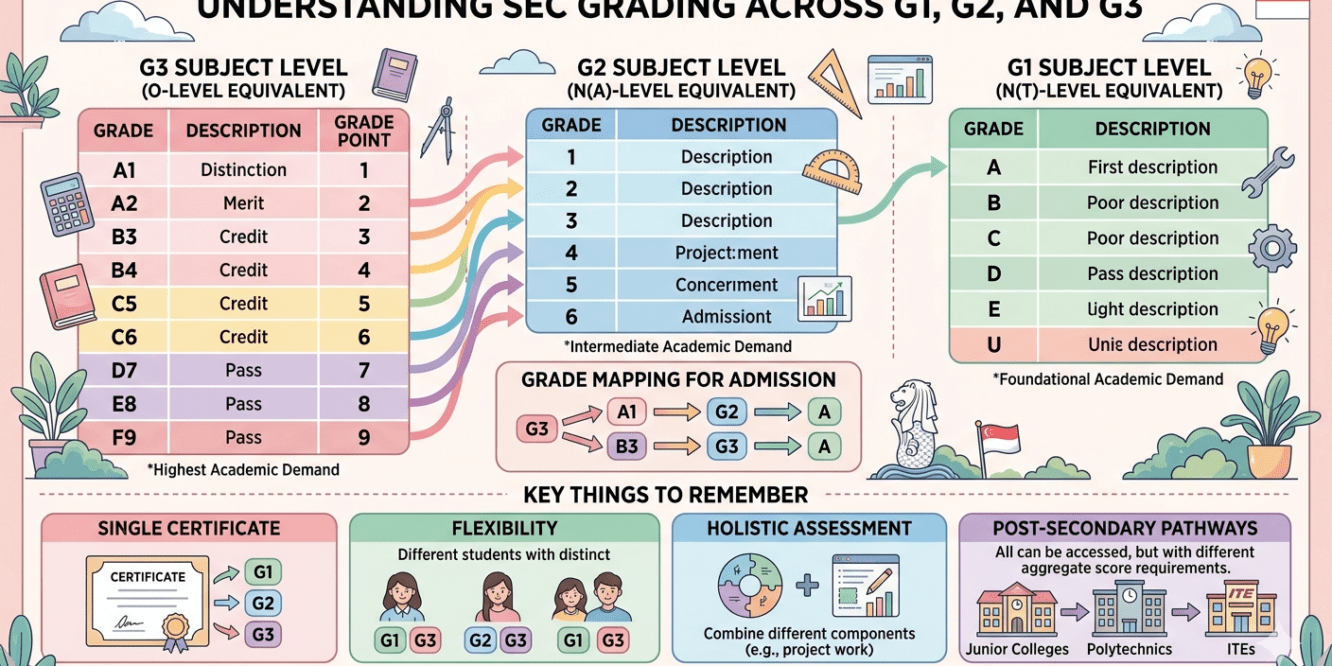
| Band | Level | Formerly | What it leads to |
|---|---|---|---|
| G3 | Advanced | Express stream | JC or Poly. A-Maths available. Highest assessment rigour. |
| G2 | Intermediate | Normal Academic | O-Level cert on separate marking scale. Strong results qualify for Poly. |
| G1 | Foundation | Normal Technical | Foundation O-Level. ITE pathways or Poly bridging with strong results. |
What Full Subject-Based Banding Actually Is
Singapore’s Ministry of Education officially rolled out Full Subject-Based Banding (FSBB) across all secondary schools from 2024. It replaced the old Express, Normal Academic and Normal Technical streams — a system in place since the 1980s and long overdue for reform. Under the old model, a student was placed into an entire stream based on their PSLE score. Under FSBB, students are placed into bands per subject. This means a child might take English at G3, Maths at G2 and Mother Tongue at G1 — all in the same year.
The three levels are G1, G2 and G3. G3 corresponds broadly to the former Express stream. G2 to Normal Academic. G1 to Normal Technical. The key word is “broadly.” The content and assessment standards have been redesigned, not simply relabelled, so parents who went through the old system should be careful about assuming they know exactly what each band involves.
For parents in Tampines, Bedok and Pasir Ris, this change has created genuine confusion — particularly around what G2 and G1 mean for their child’s future, and whether the tuition market has kept up with the change. Much of it has not.
G3 — What It Means and What the Pressure Looks Like
G3 is where most East Singapore parents want their child to be. It is the highest tier, it carries the widest range of post-secondary options, and for Maths and Science in particular it is the band that keeps JC pathways open. A student who takes G3 Maths and G3 Science — and performs well — can go on to JC and realistically sit H2 Maths, H2 Physics, H2 Chemistry or H2 Biology at A-Level.
What many parents underestimate is the pace. G3 Maths and G3 Science in secondary school cover significantly more ground than most parents remember from their own schooling. The G3 Maths syllabus includes algebra, trigonometry, geometry, statistics and probability across a tightened curriculum. G3 Science demands both conceptual understanding and the ability to apply knowledge to unfamiliar contexts — where most students struggle even at this level.
The most common mistake parents make with G3 students is assuming that being placed at G3 means the student is fine. Placement reflects relative position at PSLE, not mastery of secondary school content. Many G3 students in Tampines and Bedok find themselves in the bottom quartile of their G3 cohort by Secondary 2 — not because they are not capable, but because the jump from primary school to G3 secondary is steeper than the PSLE score suggests.
What parents often miss
Being placed at G3 is not a guarantee of performance. It is the starting point. A G3 student who does not consolidate Maths and Science foundations in Sec 1 and Sec 2 will find Upper Secondary content in Sec 3 and Sec 4 significantly harder to absorb.
G2 — The Most Misunderstood Band in Singapore
G2 is where the most confusion lives. Parents of G2 students often carry a quiet anxiety that their child has somehow been left behind — that G2 is a lesser version of education that leads to fewer options and less respect. This anxiety is understandable, but it is only partially accurate, and the part that is inaccurate does real damage to students who are perfectly capable of strong outcomes at their level.
The honest truth about G2 is this: it is a genuinely different band, not a diluted G3. G2 Maths and G2 Science are assessed on their own terms, graded on their own scale, and the O-Level certificate a G2 student receives is a real O-Level certificate that qualifies them for polytechnic courses. A student who achieves top grades in G2 Maths and G2 Science has demonstrated real academic competence.
The problem is that much of the tuition market has not caught up. Tutors who advertise “O-Level Maths tuition” in Tampines or Bedok are typically running programmes designed around the G3 syllabus. A G2 student placed in that class will spend half the session on content they are not assessed on and miss targeted practice on the components where their actual marks come from. This is not a minor inefficiency — it is the primary reason many G2 students feel that tuition is not helping even when they attend consistently.
“The issue is not that G2 students cannot learn. The issue is that they are being taught to the wrong exam.”
Effective tuition for a G2 student targets the G2 syllabus specifically, identifies the precise question types where marks are being lost, and builds competence within that framework rather than constantly pulling the student toward G3 content they are not ready for. When this is done well, G2 students frequently surprise themselves — and their parents.
G1 — Foundation Level, Real Ceiling
G1 is the foundation tier, and it requires the most honesty from parents and tutors alike. Students at G1 are working toward a Foundation O-Level certificate. The syllabus is narrower, the assessment is less complex, and the primary post-secondary pathway leads to ITE rather than directly to polytechnic.
This does not mean G1 students have no future. ITE offers real vocational qualifications that lead to meaningful careers, and strong ITE graduates can progress to polytechnic through bridging programmes. Some G1 students may also be eligible to take certain subjects at G2 level — under FSBB, a student is not locked to a single band across all subjects. But parents need to be clear-eyed about what G1 means so they can set realistic expectations.
For G1 students in East Singapore, the most important thing a tutor can do is not try to accelerate the student to G2 content prematurely. The goal is mastery within the G1 framework — strong enough to achieve top grades at G1, which keeps options open and builds the confidence that makes any future progression possible.
How Maths Differs Across G1, G2 and G3
Mathematics is the subject where the differences between G1, G2 and G3 are most consequential — because the content gaps between bands are significant, and because Maths performance at O-Level has a direct bearing on post-secondary options.
G3 Mathematics and Additional Mathematics
G3 Maths covers the full O-Level Elementary Mathematics syllabus. Students at G3 who show sufficient aptitude are also offered Additional Mathematics — A-Maths — which covers advanced algebra, calculus foundations, trigonometry and coordinate geometry. A-Maths is the bridge to H2 Maths at A-Level. G3 students who intend to take H2 Maths or H2 sciences at JC are strongly advised to take A-Maths, because the A-Level Maths content builds directly on it.
G2 Mathematics
G2 Maths covers a narrower portion of the E-Maths syllabus. Students are assessed on a paper designed specifically for the G2 band — the questions are different in style, the abstract complexity is lower, and the marking scale reflects this separate standard. G2 students do not take A-Maths. This is a significant distinction: a student performing at G2 level in Maths is not on a trajectory toward H2 Maths at JC, and planning as though they are creates unnecessary pressure and misdirected tuition effort.
G1 Mathematics
G1 Maths covers foundational numeracy and basic mathematical concepts. The paper is shorter, the question types are more concrete, and the emphasis is on practical application rather than abstract reasoning. Students who score well in G1 Maths demonstrate genuine mastery of foundational content — which matters for ITE programmes and for any future consideration of moving to G2.
How Science Differs Across G1, G2 and G3
Science at secondary school is offered in two formats: Combined Science and Pure Science. At G3, students can take either. At G2, Science is typically offered as Combined Science. At G1, Science is offered at a foundation level. The differences in content depth between bands are substantial, and assessment styles diverge significantly from Sec 3 onwards.
| Band | Science format | Subjects covered | Assessment depth |
|---|---|---|---|
| G3 | Pure or Combined | Physics, Chemistry, Biology (any two for Combined) | High — application to novel contexts, structured questions, data-based questions |
| G2 | Combined Science | Two of Physics, Chemistry, Biology | Moderate — conceptual understanding and structured application |
| G1 | Foundation Science | Core science concepts across disciplines | Foundation — direct recall and basic application; shorter paper format |
For G3 students, Pure Science is the preferred path for those aiming at JC and eventual H2 sciences at A-Level. Pure Physics, Pure Chemistry or Pure Biology each cover their subject in greater depth than the Combined Science equivalent. Tuition for G3 Science in Tampines and Bedok is most effective when it focuses on structured long questions, data analysis, and application of concepts to unfamiliar experimental scenarios.
For G2 Combined Science students, the challenge is multi-topic. The paper shifts between Physics and Chemistry in a single sitting, and students who have studied each topic in isolation often struggle to switch their thinking between domains quickly. Good tuition for G2 Combined Science builds a consistent mental model across both sciences rather than treating them as unrelated halves of the same paper.
What Tuition Actually Looks Like at Each Level
The single biggest mistake parents in East Singapore make when arranging O-Level tuition is selecting a programme without first confirming it is calibrated to their child’s actual band. This is not a minor detail. It is the difference between tuition that produces measurable grade improvement and tuition that produces weekly attendance with no change in results.
For G3 students, the tuition market is well-served. Most O-Level Maths and Science tutors and centres in Tampines, Bedok and Pasir Ris run programmes targeting the G3 paper. You still need to verify that the tutor has demonstrable results with G3 students in the specific subjects you need, and that their approach goes beyond paper drilling into genuine conceptual reinforcement.
For G2 students, the market is much thinner than it appears. Tutors and centres advertising “O-Level Maths” or “O-Level Science” are almost always running G3 programmes by default. Parents of G2 students need to ask explicitly: does this programme address the G2 syllabus specifically? A private tutor who is willing to study the G2 papers and tailor their approach accordingly is almost always more effective than a group class running a standardised programme.
For G1 students, the same logic applies. A private tutor who focuses on the Foundation Maths and Foundation Science papers — and who is honest about scope and target — will produce better outcomes than a programme designed for a different examination entirely.
A practical test for parents
When speaking to any tutor or tuition centre about your child’s O-Level Maths or Science, ask directly: “My child is taking G2 Maths — can you show me the specific G2 past year papers you use?” If they cannot produce them immediately, walk away.
Can Your Child Move Up a Band?
Yes — under the Full Subject-Based Banding system, students can be considered for promotion to a higher band within a subject. The mechanism is school-based review, typically conducted at the end of each academic year. A student who consistently performs at the top of their band in a given subject may be offered the opportunity to take that subject at the next level.
What this means in practice is that the path from G2 to G3 in Maths is real — but it requires consistent top performance at G2, not just marginal improvement. A student who scores B3 in G2 Maths is not a strong candidate for promotion. A student who scores A1 or A2 consistently, and whose teacher identifies them as ready for the higher level, may be considered.
Tuition that focuses on genuine G2 mastery — not on introducing G3 content prematurely — gives a student the best foundation for promotion. Parents should resist treating band promotion as the primary goal of tuition. The primary goal should always be maximum performance at the student’s current level. Band promotions, where they happen, follow naturally from that.
Finding O-Level Tuition in Tampines, Bedok and Pasir Ris
East Singapore has a well-developed tuition ecosystem. Tampines in particular — with its concentration of secondary schools, Tampines Hub, and surrounding residential estates — supports both tuition centres and a large network of private home tutors. Bedok and Pasir Ris round out the East with their own clusters of secondary school students forming the local tuition demand.
For G3 students taking Maths and Science, the choice between a tuition centre and a private tutor is largely a question of learning style. Group classes work well for students who are broadly on track and need structured exam practice. Private tuition works better for students with specific gaps, lower confidence, or irregular schedules.
For G2 and G1 students, the private tutor route is almost always the stronger choice — precisely because the supply of tutors who genuinely know the G2 and G1 syllabuses is limited. Online tuition has also expanded the effective radius considerably. For parents in Pasir Ris or the outer edges of Tampines, online tuition from a specialist is often a better option than in-person tuition from a generalist.
Frequently Asked Questions
What is the difference between G1, G2 and G3 in Singapore secondary schools?
G1, G2 and G3 are the three tiers of subject-based banding under FSBB. G3 is the most advanced level, equivalent to the old Express stream. G2 is intermediate, equivalent to Normal Academic. G1 is foundation, equivalent to Normal Technical. Unlike the old system, students can take different subjects at different band levels. Maths and Science are the subjects where band differences in content and assessment are most significant.
Can a G2 student do well at O-Levels in Maths and Science?
Yes. G2 students sit for a G2-specific paper graded on its own scale. A student who achieves top marks in G2 Maths and G2 Combined Science earns a legitimate O-Level result that qualifies them for polytechnic courses. The key is receiving tuition that targets the G2 syllabus specifically — not a generic programme designed for G3.
Should a G3 student take A-Maths?
G3 students intending to go to JC and take H2 Maths or H2 sciences at A-Level are strongly advised to take A-Maths. A-Maths covers content that JC H2 Maths builds directly on. Students who skip A-Maths and attempt H2 Maths at JC typically find the transition significantly harder.
What kind of tuition do G1 and G2 students need?
G1 and G2 students need tuition that addresses their specific band syllabus — not content from a higher tier. The most effective approach starts with diagnosis: the tutor identifies exactly where the student is losing marks in their actual paper, then builds a plan targeting those areas within the correct framework.
Can a G2 student move up to G3?
Yes. Under FSBB, schools review band placement annually. Students with consistent top performance — A1 or A2 grades at G2 — may be offered promotion. Tuition focused on real G2 mastery gives students the strongest foundation for this, far more than premature exposure to G3 content they are not yet ready to absorb.
Is there good O-Level tuition in Tampines, Bedok or Pasir Ris for G2 and G3 students?
East Singapore has a broad tuition ecosystem. G3 students are well-served by both tuition centres and private home tutors. For G2 students, private home tuition is typically more effective because the supply of tutors who know the G2 Maths and Science syllabuses specifically is limited. Online tuition from subject specialists has also expanded available options considerably.
Need O-Level Maths or Science Tuition in the East?
Ingel Soong works with secondary school students across G2 and G3 in Tampines, Bedok, Pasir Ris and online — with tuition calibrated to the band your child is actually sitting.