
In this article
- The statistics problem that most H2 Maths students do not see coming
- Why statistics is structurally different from pure maths
- Hypothesis testing — the single biggest mark-loss area
- Pure maths: where the marks go in calculus and vectors
- How strong your child's A-Maths foundation affects H2 Maths performance
- What effective H2 Maths tuition looks like
- H2 Further Mathematics — who should take it and who should not
- Different priorities in JC1 and JC2
- Red flags when choosing an H2 Maths tutor
- Frequently asked questions
The Statistics Problem That Most H2 Maths Students Do Not See Coming
Ask any group of JC students which part of H2 Maths they find most difficult, and you will hear a predictable range of answers: integration by parts, complex numbers, differential equations. What you will rarely hear — but what the examination data consistently shows — is statistics. Not because statistics is not a problem, but because students do not realise statistics is a problem until the marks come back and a section they thought they handled adequately has delivered far fewer points than expected.
The H2 Maths statistics component covers probability, discrete random variables, the normal distribution, sampling distributions, hypothesis testing, and correlation and linear regression. Together these topics account for roughly 40 percent of the total H2 Maths mark — a significant portion of the paper that is frequently under-prepared relative to pure maths topics like calculus and vectors, which receive the most tuition attention and the most independent study time.
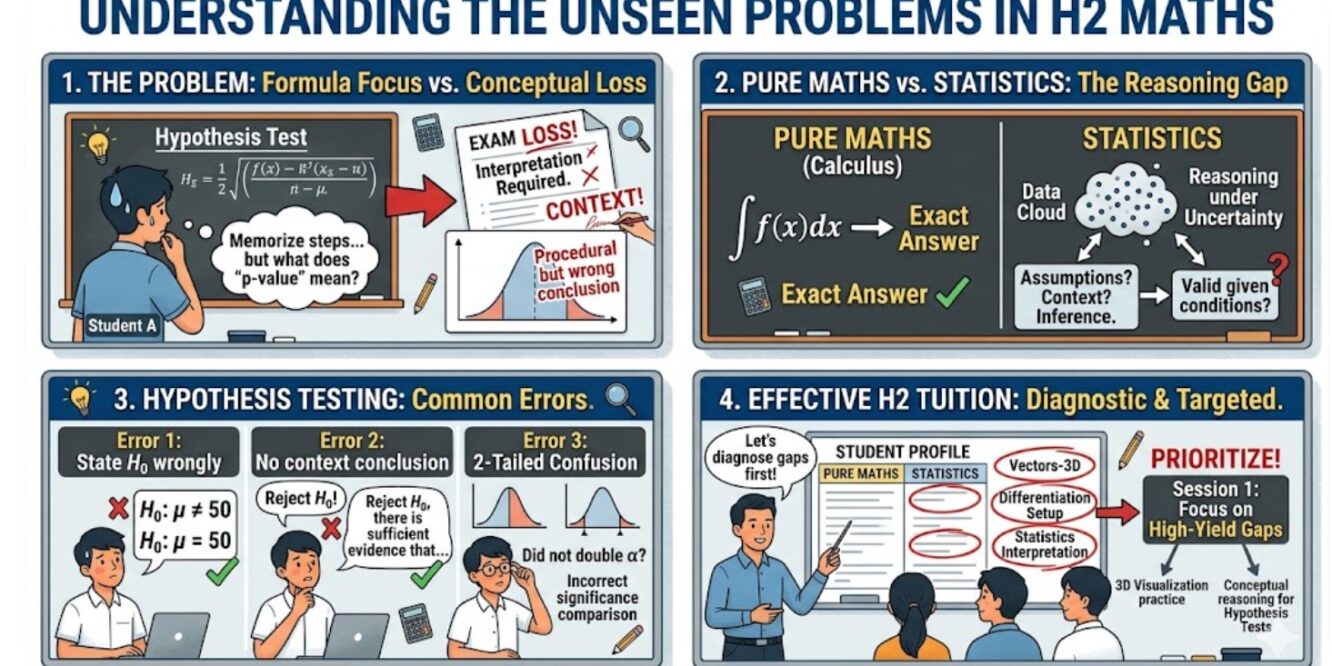
The reason statistics is under-prepared is misclassification. Students — and some tutors — treat statistics as a formula-and-procedure subject where mastery means knowing which formula to apply and how to execute the procedure correctly. This is partially true for some statistics questions, but the A-Level marking scheme consistently includes questions that ask students to interpret results, justify conclusions, comment on assumptions, and identify when a statistical method is or is not valid. These questions cannot be answered by formula application. They require understanding of what the statistical test is doing — what the null hypothesis means, what a p-value represents, why a normal approximation requires certain conditions, what the regression line does and does not tell you about causation. Students who have learned statistics procedurally rather than conceptually fail these interpretation questions even when they execute the calculations correctly.
Why Statistics Is Structurally Different From Pure Maths
Pure maths and statistics are fundamentally different modes of mathematical reasoning, and students who are strong in pure maths do not automatically transfer that strength to statistics. Understanding why helps tutors and students approach the statistics component with the right mindset rather than the approach that works for pure maths.
In pure maths, there is almost always a definitive correct answer. Integration of a function produces an exact result. A vector calculation has a unique correct answer. Complex number manipulation follows determinate rules. The student either executes the procedure correctly or does not, and the mark scheme reflects this clear right-or-wrong structure.
In statistics, the question is often about reasoning under uncertainty — about what conclusions a set of data justifies, what assumptions a model requires, or what a result means in context. The null hypothesis in a hypothesis test is either rejected or not rejected based on a comparison between the p-value and the significance level, but the student must also understand what that rejection means and whether it is valid given the sample size, the sampling method, and the nature of the data. This contextual reasoning is the part that formula-focused students consistently miss, and it is the part that the mark scheme rewards most heavily in the higher-mark statistics questions.
The practical implication for H2 Maths tuition is that statistics topics require a different teaching approach from pure maths topics. Pure maths is best taught by demonstrating a technique and then having the student practice it on progressively harder examples. Statistics is best taught by working through the conceptual reasoning behind each test or model — why the test works, what its assumptions are, what its limitations are — before introducing the formal procedure. A student who understands why hypothesis testing works will handle unfamiliar application questions. A student who has memorised the hypothesis testing procedure will handle only the questions that exactly match the procedure they memorised.
Hypothesis Testing — The Single Biggest Mark-Loss Area
Hypothesis testing in H2 Maths — covering z-tests, t-tests and chi-squared tests — is the topic that produces the most consistent and most avoidable mark loss across the Singapore JC cohort. It is avoidable because the conceptual framework, once genuinely understood, is both consistent and elegant. But it is consistent because most students learn it procedurally without that understanding, and the A-Level questions are specifically designed to detect this.
The errors that appear most frequently in H2 Maths hypothesis testing are not computational errors. Students can generally execute the arithmetic of a z-test correctly. The errors are conceptual: stating the null hypothesis incorrectly because the student has not understood what it represents rather than simply memorising that it takes a specific form; failing to state a conclusion in context because the student treats the test as complete once the mathematical comparison is done; incorrectly rejecting or not rejecting the null hypothesis when a two-tailed test is used and the student has not accounted for the doubled critical region; and making claims about causation or certainty that the hypothesis test does not support.
Each of these errors reflects the same underlying deficit: the student has learned what to do but not what it means. A tutor who teaches hypothesis testing by drilling the procedure — state H0, state H1, calculate the test statistic, compare to critical value, state conclusion — without explaining why each step is taken and what each component represents is building a procedure without a foundation. The procedure works for standard questions. It fails for questions that require any deviation from the standard form.
The correct approach to teaching hypothesis testing is to build the conceptual understanding first — what does the null hypothesis represent? what does the significance level mean? what does rejecting the null hypothesis actually claim? — and then introduce the formal procedure as the mathematical expression of that understanding. This takes longer in the short term. It produces substantially better results in the examination.
Pure Maths: Where the Marks Go in Calculus and Vectors
While statistics is the hidden mark killer, pure maths contains its own consistent sources of avoidable mark loss that are worth understanding specifically.
Integration techniques
Integration by parts, integration by substitution, and integration using partial fractions are the three techniques that appear most consistently in H2 Maths papers. The common failure mode is recognising which technique applies — the technique itself, once identified, is mechanical. Students who cannot reliably identify whether a given integral calls for parts, substitution, or partial fractions before beginning the calculation lose time and marks on questions where the integration itself would have been straightforward if the right approach had been chosen from the start. Training this recognition — presenting students with integrands and asking them to identify the technique before executing it — is one of the highest-return activities in H2 Maths tuition.
Differential equations
Differential equations in H2 Maths require students to set up a model from a contextual description, solve it, and interpret the solution in context. The setup step is where most marks are lost — students who can solve a separable differential equation once given the equation often cannot correctly formulate the equation from a word problem that describes a rate of change. This modelling skill is distinct from the solving skill and requires specific practice on contextual setup questions, not just on solution technique.
Vectors
Vectors in three dimensions — lines, planes, and the relationships between them — is the topic that most consistently produces errors in students who understood two-dimensional coordinate geometry at O-Level. The extension to three dimensions is not conceptually difficult, but the notation is dense and the spatial visualisation is more demanding. Students who struggle to visualise a line intersecting a plane benefit from explicit geometric reasoning — drawing cross-sections, labelling directions — before attempting algebraic solutions. A tutor who teaches vectors purely algebraically, without building geometric intuition alongside the algebra, produces students who can follow a solution but cannot initiate one for a novel geometric configuration.
How Strong Your Child's A-Maths Foundation Affects H2 Maths Performance
The relationship between O-Level A-Maths and JC H2 Maths is more direct than most students appreciate until they are in JC and experiencing the consequences. A-Maths at O-Level covers differentiation, integration, trigonometric functions and coordinate geometry at a level that H2 Maths assumes as prior knowledge in JC1. A student who genuinely understood A-Maths — who can differentiate and integrate standard functions fluently, who understands the relationship between a function and its derivative geometrically as well as algebraically — arrives at JC H2 Maths with a foundation that makes the new content accessible. A student whose A-Maths was adequate for the O-Level paper but not deeply understood finds JC1 H2 Maths significantly harder because the assumed prior knowledge is shaky.
Students who took only E-Maths at O-Level — which does not cover calculus — face the steepest transition to H2 Maths. They must absorb the calculus foundations that A-Maths students built over two years in a much shorter window, while simultaneously managing the rest of the JC1 content. These students benefit significantly from targeted pre-JC or early JC1 tuition focused specifically on the A-Maths content they did not cover, particularly differentiation and its applications, before the JC1 calculus syllabus begins.
For students who took A-Maths but underperformed — achieving a C or D grade — the question is whether the underperformance reflected a genuine understanding deficit or a performance-on-the-day variation. A student who scored C in A-Maths but who can demonstrate solid calculus understanding when assessed directly is in a different position from one who scored C because the calculus concepts were never genuinely absorbed. The first student needs examination technique support in JC Maths. The second needs foundational remediation before JC1 content becomes accessible.
What Effective H2 Maths Tuition Looks Like
Effective H2 Maths tuition is diagnostic first and then targeted. The first session with any new H2 Maths student should produce a clear map of where the student's understanding is solid and where it is not — across both pure maths and statistics — so that subsequent sessions can prioritise the highest-yield areas rather than covering the syllabus systematically regardless of what the student already knows.
For pure maths, effective tuition presents novel problems rather than only past-year questions. A student who has seen a past-year integration question three times may be able to reproduce the solution from memory without genuine understanding. A tutor who presents a structurally similar but numerically or functionally different problem exposes whether the understanding is real or the recall is superficial. This distinction matters enormously for the A-Level paper, which presents questions that are never exactly like past-year questions even when they test the same technique.
For statistics, effective tuition requires the tutor to understand the conceptual framework deeply enough to explain what each test means, not just how to execute it. A tutor who teaches hypothesis testing purely procedurally — who cannot explain what a p-value represents or why the significance level is set before the data is examined rather than after — is not equipped to develop the conceptual understanding that A-Level statistics questions reward. Parents evaluating H2 Maths tutors should ask specifically about the statistics component: how does the tutor teach hypothesis testing? Can they explain what the null hypothesis represents in plain terms? The answers reveal more about subject mastery than any number of qualifications.
H2 Further Mathematics — Who Should Take It and Who Should Not
H2 Further Mathematics is a separate H2 subject available to students with strong mathematical ability who want to study more advanced pure mathematics beyond the standard H2 Maths syllabus. It covers topics including matrices, proof by induction, complex numbers at a deeper level, numerical methods and further calculus that are not in the standard H2 Maths syllabus.
The students who genuinely benefit from H2 Further Maths are those who find standard H2 Maths relatively straightforward, who have a genuine passion for mathematics rather than simply a pragmatic approach to it, and who are targeting mathematics, physics, or quantitative finance at top universities where exceptional mathematical ability is a meaningful signal. For these students, H2 Further Maths is both a demonstration of capability and a foundation for university-level mathematics.
The students who should not take H2 Further Maths are those who are already stretched by their standard H2 subject load, those who are taking Further Maths because they believe more H2 subjects automatically strengthens a university application, and those whose interest in mathematics is primarily instrumental rather than genuine. Taking H2 Further Maths alongside H2 Chemistry, H2 Physics and H2 Biology creates a subject load that very few students can sustain at a high level across all four subjects simultaneously. A student who scores AAA in three H2 subjects without Further Maths is in a stronger position than one who scores ABBB across four H2 subjects including Further Maths.
Different Priorities in JC1 and JC2
In JC1, H2 Maths tuition should prioritise building genuine algebraic and calculus fluency alongside the JC1 statistics foundations. The JC1 Maths content — functions, graphs, sequences and series, vectors, differentiation and basic integration, probability and distributions — establishes the mathematical toolkit that JC2 content draws on. A student who enters JC2 with confident, fluent JC1 Maths skills can absorb JC2 content at the school's pace. A student who enters JC2 with shaky JC1 foundations will find the pace unmanageable.
In JC2, the priority shifts to completing the statistics component — particularly hypothesis testing and correlation — and integrating the full two-year syllabus for examination preparation. JC2 H2 Maths tuition should include substantial timed paper practice under examination conditions, with specific attention to technique selection in the pure maths paper and conceptual accuracy in the statistics paper. The two papers in H2 Maths — Paper 1 (pure maths) and Paper 2 (statistics and some pure) — have different performance profiles for most students, and a good JC2 tutor will track performance across both papers separately rather than treating the subject as a single entity.
Red Flags When Choosing an H2 Maths Tutor
Cannot explain what a p-value means in plain terms. This is the single clearest test of whether a tutor genuinely understands H2 statistics. If a tutor cannot explain, without using jargon, what a p-value represents and why it is compared to the significance level in hypothesis testing, they do not understand the conceptual foundation of the statistics component they are being paid to teach.
Teaches integration by drilling question types without technique selection training. A tutor who presents integration questions categorised by technique — here are the integration by parts questions, here are the substitution questions — is not training the skill that the examination tests. The examination presents unsorted integrands and the student must select the technique. Teaching technique execution without selection training produces students who can solve categorised practice problems but fail unsorted examination questions.
Spends more than 70 percent of session time on pure maths and less than 30 percent on statistics. Given that statistics accounts for roughly 40 percent of the H2 Maths mark, a tutor who consistently neglects it in favour of pure maths is producing lopsided preparation. A well-balanced H2 Maths tuition programme allocates session time roughly proportionally to the mark weight of each component, adjusted for where the individual student's gaps are most significant.
Uses only past-year papers as practice material. Past-year papers are essential but insufficient for genuinely developing mathematical skill. A tutor who has no original question bank and relies entirely on past-year papers is limited to the questions that have already been examined. H2 Maths questions are carefully designed to test reasoning rather than memorisation, and a student who has seen every past-year paper multiple times may be pattern-matching rather than genuinely reasoning. Original problems from a tutor who understands the syllabus deeply test reasoning in a way that repeated past-year exposure cannot.
Frequently Asked Questions
Why do H2 Maths students lose so many marks in statistics?
Because statistics requires conceptual understanding of what statistical tests mean — not just procedural execution of the tests. Students who memorise the hypothesis testing procedure without understanding what a p-value represents, or who apply distributions without understanding when their assumptions are valid, consistently lose marks on interpretation questions that account for a significant portion of statistics marks. The statistics component is treated as a formula subject by most students but assessed as a reasoning subject by the examination.
Is H2 Maths harder than O-Level Maths?
Yes, significantly. H2 Maths introduces calculus, complex numbers, vectors, differential equations and statistics that have no direct O-Level equivalent. The level of abstraction is higher, the proof and reasoning requirements are more demanding, and examination questions require the ability to recognise which technique applies rather than simply applying a known method. Students who took A-Maths at O-Level are better prepared for H2 Maths than those who took only E-Maths.
What are the hardest topics in H2 Maths?
Statistics — particularly hypothesis testing and its interpretation — is the most consistently under-prepared component and the biggest hidden mark-loss area. In pure maths, integration technique selection, differential equation modelling, and three-dimensional vector geometry are the most consistent sources of avoidable mark loss. Complex numbers and Maclaurin series are demanding but typically well-covered in tuition programmes.
How much does H2 Maths tuition cost in Singapore?
Established full-time private tutors charge $90–$140 per hour. Ex-MOE or ex-JC Maths teachers charge $130–$170 per hour. Tuition centres charge $280–$450 per month for group classes. At four 1.5-hour sessions monthly with an established private tutor, expect $540–$840 per month. Rates are consistent with other H2 science subjects.
Should a JC student take H2 Further Mathematics?
Only if they genuinely find standard H2 Maths relatively straightforward and have a real interest in mathematics beyond what is required for their other subjects. H2 Further Maths adds significant workload and is only worthwhile for students targeting mathematics, physics or quantitative finance at top universities who can sustain high performance across four H2 subjects simultaneously. For most students, achieving AAA in three H2 subjects is more valuable than achieving ABBB across four.
Continue reading
JC Tuition in Tampines: Private Tutor vs Tuition Centre for H2 Maths, Chemistry and Physics
JC1 vs JC2: What Changes, Why Most Students Fall Behind in JC2
A-Level Tuition Fees Singapore 2025: What Parents Are Actually Paying
Struggling with H2 Maths Statistics or Calculus?
Ingel Soong teaches H2 Maths with a conceptual-first approach — building the understanding that both pure maths and statistics questions demand. East Singapore and online.