
In this article
- What the Integrated Programme actually is and how it works
- How IP differs from mainstream secondary school — and why tuition needs differ
- The no-O-Level problem — how gaps accumulate without checkpoints
- How IP Maths differs from O-Level and A-Level Maths
- How IP Sciences differ from mainstream secondary school sciences
- IP schools in Singapore and their curriculum differences
- What effective IP tuition looks like
- Why a mainstream O-Level tutor often cannot serve IP students from Year 3 onwards
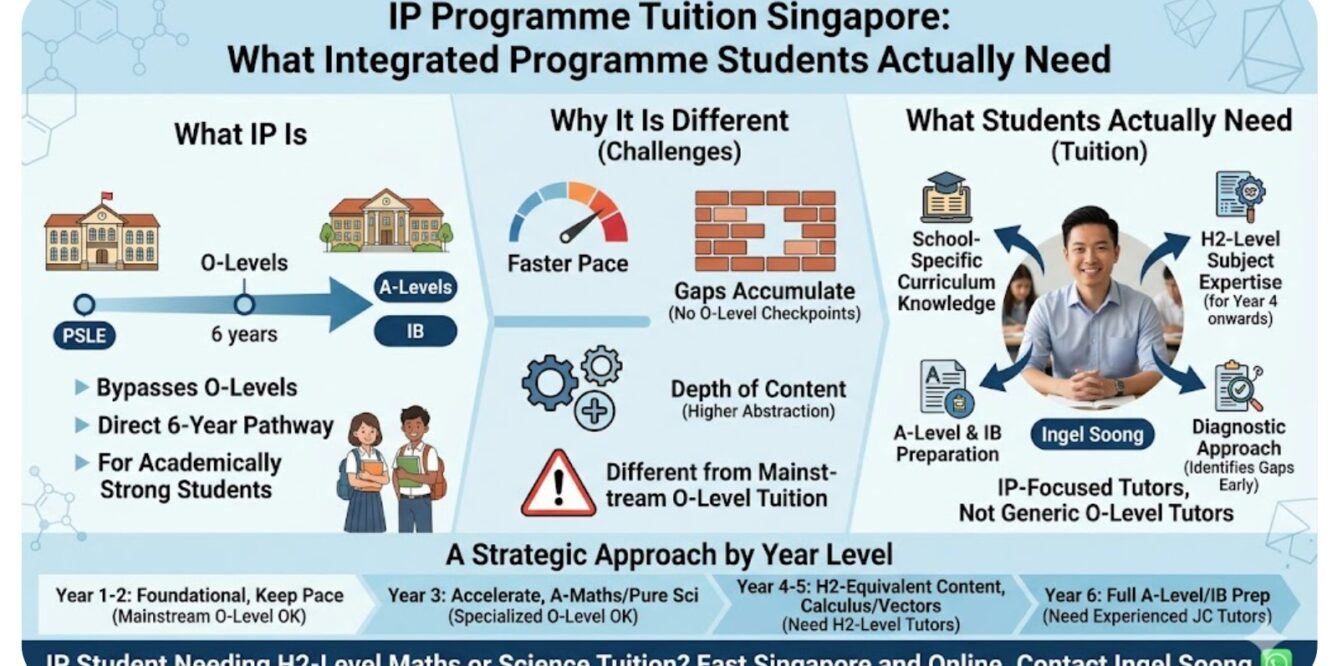
- Tuition strategy by IP year level
- Frequently asked questions
What the Integrated Programme Actually Is and How It Works
The Integrated Programme is a six-year secondary-to-JC pathway offered by a select group of Singapore schools — including Raffles Institution, Hwa Chong Institution, Nanyang Girls' High School, Victoria School, Catholic High School, River Valley High School, Anglo-Chinese School (Independent) and several others. Students enter the IP through the Primary 1 Registration Exercise or through the PSLE-based Secondary 1 posting, with IP schools taking students who have demonstrated strong academic performance. Once enrolled, IP students proceed through six years of school without sitting the O-Level examination — bypassing the major checkpoint that structures the mainstream secondary-to-JC pathway.
At the end of six years, IP students sit either the Singapore-Cambridge A-Level examination (at schools that partner with JCs, such as Raffles Institution and Raffles Junior College, or Hwa Chong Institution and Hwa Chong Junior College) or the International Baccalaureate Diploma (at schools like ACS Independent, St Joseph's Institution, or Dunman High School). The IP is designed to give schools flexibility to offer a richer, more challenging curriculum than the O-Level syllabus allows, with the assumption that students selected for IP programmes can handle the pace and depth.
For parents of IP students, the key structural feature of the programme is what it lacks: the O-Level examination as a midway accountability checkpoint. In the mainstream system, the O-Level examination at the end of Secondary 4 provides a clear assessment of where a student's knowledge is solid and where it is not. For IP students, the only formal national assessment is at the end of Year 6 — the A-Level or IB. In between, academic progress is measured by school-internal examinations whose formats and standards vary between IP schools.
How IP Differs From Mainstream Secondary School — and Why Tuition Needs Differ
The differences between the IP and the mainstream secondary school curriculum are significant enough to make generic O-Level tuition actively unhelpful for IP students from Year 3 onwards — not just inefficient, but potentially misleading because the content being taught in an O-Level tuition programme may be the wrong content for the examination the IP student will actually sit.
IP Maths, Chemistry, Physics and Biology are all accelerated relative to their mainstream counterparts. The IP curriculum compresses the O-Level content into approximately the first three to four years of the programme and then extends into content that mainstream students encounter only at JC level. An IP student in Year 4 at Raffles Institution or Hwa Chong is typically working with Maths content that a mainstream G3 student will not encounter until JC1. An IP student in Year 5 is effectively in a JC1 equivalent for many of their core subjects.
The assessment styles in IP schools also differ from both the O-Level and A-Level examination formats. Each IP school develops its own internal examination papers, and while these broadly align with the content students will eventually be assessed on at A-Level or IB, the specific question styles, marking criteria and expected response formats vary between schools and between year levels. A tutor who does not know the specific IP school's examination style is working with incomplete information about what the student actually needs to prepare for.
The No-O-Level Problem — How Gaps Accumulate Without Checkpoints
The most significant and least discussed challenge of the IP pathway is the absence of formal assessment checkpoints across the six years. In the mainstream system, a student who develops a significant knowledge gap in Secondary 3 Maths will see it reflected in their O-Level result — a concrete, externally validated signal that the gap exists and needs to be addressed. An IP student who develops the same gap in Year 3 may receive a weaker school internal examination result, but the absence of external validation means that the gap can be underestimated by both the student and their parents, and can accumulate through Year 4 and Year 5 before becoming a structural problem in Year 6 when the A-Level examination arrives.
This accumulation problem is compounded by the IP's faster pace. A mainstream student who falls behind in one term has approximately the same content volume to catch up as they fell behind by. An IP student who falls behind in one term at a school that covers content faster than mainstream is further behind relative to the cohort — and catching up while simultaneously absorbing the current term's content, which moves faster than ever, is genuinely hard.
Parents of IP students who notice declining internal examination results should treat them as seriously as parents of mainstream students treat O-Level common test declines — with the added awareness that the gap revealed by an IP internal examination may be harder to see clearly than the gap revealed by an external O-Level examination with standardised marking. A tutor who diagnoses the IP student's actual knowledge gaps — across the full scope of the IP curriculum, not just the most recent topics — is providing the most valuable possible early intervention.
How IP Maths Differs From O-Level and A-Level Maths
IP Maths is the subject where the divergence from mainstream curricula is most significant and most practically consequential for tuition decisions. The IP Maths curriculum across six years is designed to build a mathematical foundation that transitions smoothly into H2 Maths — which means IP students encounter calculus, vectors and complex numbers significantly earlier than mainstream students, and at a depth that exceeds O-Level A-Maths in the later IP years.
In the early IP years — Year 1 and Year 2 — the Maths content is broadly consistent with mainstream Lower Secondary E-Maths, though often covered at a faster pace and with greater abstraction. A competent O-Level Maths tutor can serve IP students adequately at this stage. From Year 3 onwards, the curriculum accelerates. Most IP schools introduce A-Maths equivalent content in Year 3, calculus in Year 4, and JC1-equivalent Maths content — functions, sequences, further calculus — in Year 5. By Year 6, IP students are effectively doing JC2 H2 Maths alongside their other subjects.
The consequence for tuition is that an IP student in Year 4 or 5 needs a tutor who is genuinely comfortable with H2-level Mathematics — who can explain the calculus and algebraic content of the IP curriculum at the depth the IP school's examinations require. A tutor whose expertise stops at O-Level A-Maths will be adequate for IP Year 3 but increasingly inadequate from Year 4 onwards. Parents who do not change their tutor as their child progresses through IP years risk keeping an arrangement that was appropriate early on but has become mismatched to the student's actual needs.
How IP Sciences Differ From Mainstream Secondary School Sciences
IP Chemistry, Physics and Biology follow the same acceleration pattern as Maths. In the early IP years, the content broadly overlaps with mainstream Lower Secondary Science. From Year 3, the content deepens into territory that mainstream students encounter at O-Level Pure Science level. From Year 5, the content extends into H2-equivalent territory — organic chemistry mechanisms in IP Chemistry, electromagnetic induction in IP Physics, molecular genetics in IP Biology — that mainstream students encounter at JC level.
The specific content encountered in IP Year 5 and Year 6 Sciences is effectively H2 content, and the internal examinations at this level require responses that would be adequate for an H2 examination question. A tutor who does not know the H2 Chemistry, H2 Physics or H2 Biology syllabus at the depth required for A-Level teaching cannot effectively prepare an IP Year 5 or Year 6 student for their school's internal examinations.
There is also a practical research and project component in many IP Science programmes that has no direct mainstream equivalent. IP students are often required to conduct original investigations, write extended essays or reports, and present findings to teachers and peers. These components require skills — scientific writing, data analysis, experimental design — that a purely examination-focused tutor may not be equipped to develop. Parents of IP students should ask prospective tutors specifically whether they are experienced with IP project work, not just IP examination content.
IP Schools in Singapore and Their Curriculum Differences
The IP is not a single standardised programme — it is a framework within which each school develops its own curriculum, assessment style and content sequencing. This means that an IP student at Raffles Institution is on a different curriculum from an IP student at Hwa Chong Institution, who is on a different curriculum from an IP student at Anglo-Chinese School (Independent), and so on. The differences are significant enough that a tutor with strong experience at one IP school may need time to understand the curriculum expectations at another before they can serve a student from that school effectively.
The schools that offer the A-Level pathway at the end of IP — including Raffles Institution and Hwa Chong Institution, which partner with their affiliated JCs — have curriculum structures that are most directly aligned with H2 Maths and H2 Science content in the later IP years. The schools that offer the IB Diploma — including ACS Independent, Dunman High School, and St Joseph's Institution — have a different curriculum structure in the later years, and the IB requires its own specific preparation that is distinct from A-Level preparation even where the content overlaps.
Parents of IP students should tell any prospective tutor which school their child attends, which year they are in, and which subject they need help with — and then ask the tutor whether they have experience specifically with that school's IP curriculum. A tutor who says yes should be asked how recent that experience is and whether they can describe specific ways in which the school's IP curriculum differs from the mainstream syllabus. A tutor who cannot answer these questions has not worked with IP students from that school before and will need time to develop that familiarity at the parent's expense.
What Effective IP Tuition Looks Like
Effective IP tuition begins with the same diagnostic principle as all good tuition: assess the student's current knowledge before determining what to teach. For IP students, this diagnostic needs to cover the IP-specific content they have been taught to date — not just the mainstream O-Level or A-Level syllabus — because the IP curriculum may have introduced topics in a different order, at a different pace, or with different emphasis than mainstream curricula.
Once the diagnostic is complete, the most effective IP tuition maintains alignment with the specific IP school's curriculum and assessment format. This means the tutor knows which topics are covered in which IP year at that specific school, which examination formats the school uses for internal assessments, and what the marking criteria for extended answers look like in that school's context. A tutor who teaches to a generic A-Level or O-Level standard rather than to the IP school's specific expectations is preparing the student for an examination that does not quite match what they will actually sit.
For the later IP years — Year 5 and Year 6 — the most effective tuition is effectively H2-level tuition, and the criteria for evaluating it are the same as those for evaluating any H2 tutor: does the tutor explain principles before formulas? can they handle unfamiliar applications? do they include examination strategy alongside content? These questions apply equally to IP Year 6 Maths and Physics tuition and to JC2 H2 Maths and Physics tuition, because the content is effectively the same.
Why a Mainstream O-Level Tutor Often Cannot Serve IP Students From Year 3 Onwards
This is the most practically important point in this article, and it is worth stating clearly. A tutor whose subject expertise is calibrated to the O-Level syllabus — who knows E-Maths and A-Maths at O-Level standard, or who knows Combined Science at O-Level standard — is adequate for IP Year 1 and 2 students and borderline adequate for IP Year 3 students. From Year 4 onwards, the content that IP students are assessed on has moved beyond the O-Level scope, and a tutor whose knowledge does not extend into H2-level territory is not equipped to address the content gaps that are causing the student's difficulties.
This mismatch is genuinely common and genuinely costly. Parents who arrange tuition for their IP Year 4 child with a tutor who served them well in Years 1 and 2 often find that the tuition continues to feel familiar and comfortable while the student's school results decline — because the tutor is covering content in their comfort zone that is no longer the content causing the student's difficulties. The tutor does not intend to mislead. They simply do not know what they do not know about the IP Year 4 or Year 5 curriculum at the specific school, and they default to teaching what they know.
The solution is straightforward: assess your IP student's tutor annually as the student progresses through year levels. Ask the tutor explicitly to describe the most advanced content they covered with the student in the past three months. If the answer describes content that is clearly within O-Level scope while your IP Year 4 or Year 5 child's school is teaching JC-equivalent content, the tutor-student mismatch has already developed.
Tuition Strategy by IP Year Level
IP Year 1 and 2: tuition is optional for most IP students unless they are struggling to keep pace with the accelerated curriculum. A competent O-Level tutor can serve IP students adequately at this level. The most important thing at this stage is ensuring that the foundational concepts — particularly in Maths — are genuinely understood rather than superficially absorbed at the IP's faster pace. An IP student who develops a shallow understanding of Year 1 algebra will face compounding difficulties in Year 3 and beyond.
IP Year 3: the content is accelerating toward A-Maths equivalent level in Maths and toward Upper Secondary Pure Science level in the sciences. Tutors who know only mainstream Lower Secondary content are becoming inadequate. A tutor with strong O-Level A-Maths and Pure Science knowledge is more appropriate at this stage. The diagnostic questions about tutor capability become more important here than in earlier years.
IP Year 4 and 5: the content is at JC1 equivalent level in Maths and Sciences. The appropriate tutor is one who is comfortable with H2-level content — who knows the H2 Maths, H2 Chemistry, H2 Physics or H2 Biology syllabus at A-Level examination depth. The tutor should also know the specific IP school's examination format and content sequencing at this level.
IP Year 6: tuition is effectively A-Level or IB tuition. The student is in the examination year, the content is at full H2 or IB level, and the preparation strategy — integration of the full six-year curriculum, examination technique, paper practice — is equivalent to what JC2 A-Level students require. All of the advice on JC2 tuition in the JC1 vs JC2 article on this site applies directly to IP Year 6 students.
Frequently Asked Questions
What is the Integrated Programme (IP) in Singapore?
The IP is a six-year through-train programme at selected Singapore secondary schools that allows students to bypass the O-Level examination and proceed directly to A-Levels or the IB Diploma. Schools offering the IP include Raffles Institution, Hwa Chong Institution, Nanyang Girls' High School, Victoria School, ACS Independent, and others. Students are selected based on PSLE performance and are expected to maintain high academic standards throughout the six years.
Do IP students need tuition in Singapore?
Many do, particularly from Year 3 onwards when the content accelerates beyond mainstream O-Level scope. The absence of O-Level checkpoints means gaps can accumulate without formal external assessment revealing them. IP students need tutors who know the specific IP school's curriculum and assessment style — not generic O-Level or A-Level tutors — because the content and examination formats differ meaningfully from both mainstream pathways.
How is IP Maths different from O-Level or A-Level Maths?
IP Maths is accelerated across six years, introducing calculus and advanced algebra in Year 3 or 4 — significantly earlier than mainstream students. By Year 5, IP Maths content is effectively at JC1 H2 Maths level. By Year 6, it is at JC2 H2 Maths level. A tutor who knows only O-Level A-Maths is adequate for IP Year 1–3 but increasingly inadequate from Year 4 onwards. From Year 4, an IP student needs a tutor with genuine H2-level Maths knowledge.
What should I look for in a tutor for my IP student?
Experience specifically with IP students from the same school or IP programme. Knowledge of the specific IP school's curriculum and examination format. H2-level subject knowledge from Year 4 onwards. Evidence of previous IP students' outcomes — not just credentials. Ask the tutor to describe the most advanced content they have taught to IP students at the relevant year level. If the description does not match what your child's school is currently teaching, the tutor's expertise is mismatched.
Can a mainstream O-Level tutor tutor an IP student?
Yes for IP Year 1 and 2. Borderline adequate for Year 3. Increasingly inadequate from Year 4 onwards, when IP content moves beyond O-Level scope into H2-equivalent territory. From Year 4, an IP student needs a tutor with H2-level subject knowledge. Parents who keep an O-Level-calibrated tutor beyond Year 3 typically see the tuition becoming less effective without a clear reason — the reason is that the tutor's knowledge ceiling has been reached by the student's advancing curriculum.
Continue reading
H2 Chemistry Tuition Singapore: The Organic Chemistry Problem and How to Actually Fix It
H2 Maths Tuition Singapore: Why Statistics Is the Hidden Mark Killer
IP Student Needing H2-Level Maths or Science Tuition?
Ingel Soong teaches at H2 level across Maths, Chemistry and Physics — suitable for IP Year 4 to 6 students preparing for A-Levels. East Singapore and online.