
In this article
- The transition from PSLE to secondary school that nobody prepares parents for
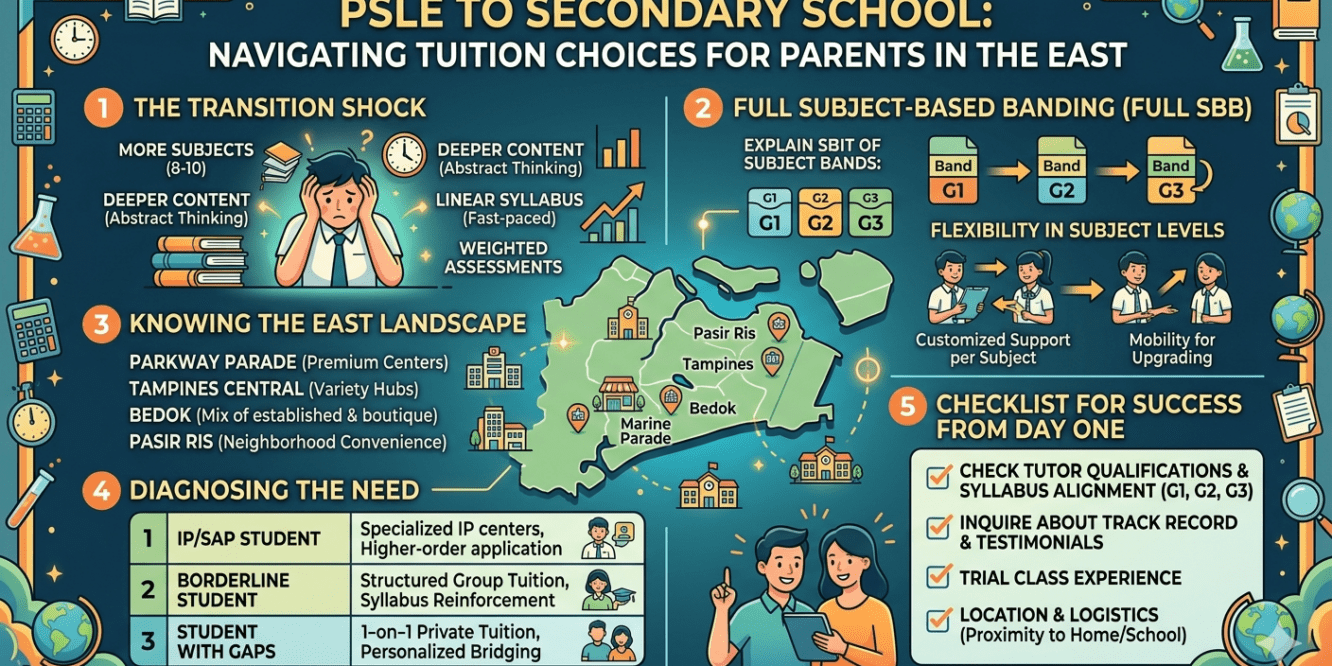
- What actually changes when your child enters secondary school
- The Maths shift: why primary school strength does not guarantee secondary success
- The Science shift: from one subject to three disciplines
- Starting on the right foot by G-band level
- When exactly to start tuition — and what to do first
- Private tutor vs tuition centre for Secondary 1 students
- Secondary schools in Tampines, Bedok and Pasir Ris
- The three mistakes East Singapore parents make in Secondary 1
- Frequently asked questions
The Transition from PSLE to Secondary School That Nobody Prepares Parents For
PSLE results come out and the collective exhale from Singapore parents is almost audible. The years of primary school tuition, the assessment books, the Saturday morning practice papers — all of it leads to that one afternoon in November when the score appears. Then, for many families, there is a period of genuine relief. The child got into a decent school. The pressure is off. There is time to breathe before secondary school starts in January.
This relief, understandable as it is, creates a specific problem. Parents who spend years of focused attention on their child’s primary school education often shift into a more passive posture at exactly the moment when the academic demands on their child are about to increase significantly. Secondary school is harder than primary school. The content is deeper, the subjects are more numerous, the pace is faster, and the assessment style changes in ways that catch even strong PSLE performers off guard.
For parents in Tampines, Bedok and Pasir Ris — where a large concentration of secondary schools means a large proportion of families are navigating this transition simultaneously — the question of what kind of academic support to arrange, and when, is one that deserves more careful thought than most families give it in the December holiday window between PSLE results and the start of secondary school.
This article is a straightforward guide to that decision. Not a sales pitch for tuition at all costs — some students make the transition well without external support, and it is worth acknowledging that. But an honest assessment of what changes in Secondary 1, where the risks are, and what parents in the East can do to set their child up well from the start.
What Actually Changes When Your Child Enters Secondary School
The scale of change between primary and secondary school is something most parents intellectually understand but few have mapped out in concrete detail. It is worth doing this clearly, because the specific nature of what changes determines what kind of support actually helps.
The most immediate change is subject structure. In primary school, Science is one subject. In secondary school, it becomes three — Physics, Chemistry and Biology — each with its own conceptual framework, its own vocabulary, and its own way of asking questions. A student who was strong in primary Science is not automatically well-prepared for any of these three. The primary Science syllabus emphasises observation, basic classification and simple cause-and-effect relationships. Secondary Physics introduces forces, motion and energy in a way that requires mathematical reasoning. Secondary Chemistry introduces atomic theory, bonding and chemical reactions in a way that requires abstract modelling. Secondary Biology introduces cellular biology and genetics in a way that requires a different kind of systematic thinking. These are not extensions of primary Science — they are new disciplines.
Mathematics undergoes a similar transformation. Primary school Maths is anchored in model drawing, heuristics and concrete problem-solving. Secondary school Maths begins immediately with algebra — working with unknowns, manipulating equations, graphing functions. A student who solved every primary school Maths problem by drawing a bar model will find that approach does not transfer. The secondary school Maths teacher assumes algebraic thinking from very early in Secondary 1, and students who have not made the conceptual shift struggle within the first term.
Beyond subject content, the volume of independent work expected of a secondary school student is significantly higher than in primary school. Secondary school teachers move through the syllabus at a pace that assumes students will consolidate their understanding outside of class. In primary school, consolidation often happened through structured homework supervised by parents or tutors. In secondary school, that structure is less prescribed, and students who have not developed independent study habits find themselves falling behind without a clear signal of where the gap began.
The Maths Shift: Why Primary School Strength Does Not Guarantee Secondary Success
This is the point that surprises the most parents, so it is worth addressing directly. A child who scored well in PSLE Maths — who was strong at model drawing, good at rate and ratio problems, reliable on fractions and percentages — is not necessarily well-prepared for Secondary 1 Maths. This is not because their primary school learning was inadequate. It is because the two subjects require genuinely different cognitive skills, and the PSLE score measures competence in the primary school skill set, not readiness for the secondary one.
Secondary 1 Maths begins with algebra. Students are introduced to the concept of a variable — a letter that represents an unknown quantity — and are expected to manipulate expressions containing variables, solve linear equations, and understand the relationship between equations and graphs. For a student who has spent six years thinking about numbers concretely, this abstract shift is genuinely challenging. Many students who were among the top Maths performers in primary school find themselves in the bottom third of their secondary school Maths class within the first few months, not because they have become less capable but because they have not yet made the cognitive shift that secondary school Maths demands.
The compounding problem is that secondary school Maths is a cumulative subject in a way that primary school Maths is not. Secondary 1 algebra is the foundation on which Secondary 2 simultaneous equations are built. Secondary 2 simultaneous equations are the foundation on which Secondary 3 quadratic equations are built. A student who does not fully consolidate Secondary 1 algebra by the end of the year is not just behind in Secondary 1 — they are setting up a deficit that will make every subsequent year harder. This is why the first term of Secondary 1 Maths is disproportionately important, and why parents who notice early struggle and act on it quickly get much better outcomes than those who wait.
“A shaky Secondary 1 Maths foundation does not stay in Secondary 1. It follows the student into every year that comes after.”
The Science Shift: From One Subject to Three Disciplines
The shift from primary Science to secondary school Physics, Chemistry and Biology is less discussed than the Maths transition but is in many ways more disorienting for students. In primary school, Science is a holistic subject where students learn about plants, animals, matter, energy and systems in an integrated way. In secondary school, three separate teachers walk into three separate classrooms and begin teaching three separate disciplines that each have their own internal logic.
Physics in Secondary 1 and 2 introduces concepts like speed, velocity, acceleration, density and pressure — all of which require students to apply mathematics in ways that primary school Science did not. A student who is simultaneously adjusting to secondary school Maths may find the mathematical demands of secondary Physics compounding their confusion. The two subjects reinforce each other when a student understands both — but when a student is struggling with algebra in Maths, the equations in Physics can feel doubly overwhelming.
Chemistry in lower secondary introduces the particulate nature of matter — the idea that everything is made of atoms and molecules that behave according to specific principles. This is a conceptual leap that many students find difficult because it requires reasoning about things that cannot be directly observed. A student who is good at memorising facts may do adequately in the early Chemistry content, but the subject quickly reveals whether a student can think about invisible structures and processes — a skill that primary Science did not develop systematically.
Biology in lower secondary covers cells, nutrition, transport and reproduction across both plants and animals. It is the most content-heavy of the three sciences and requires students to manage a large volume of specific terminology from the outset. Students who are strong readers and systematic note-takers tend to find Biology more manageable early on, while students who learn better through problem-solving may find it less intuitive than Physics or Chemistry.
The practical implication of this three-way split is that parents should not assume that a child who was good at primary Science will be good at all three secondary sciences. Each discipline rewards different strengths, and a student’s performance across the three will often be uneven in ways that are not predictable from their primary school record.
Starting on the Right Foot by G-Band Level
Under Full Subject-Based Banding (FSBB), a student entering secondary school in 2025 is placed at G1, G2 or G3 in each subject based on their PSLE performance. The band a student is placed in is the starting point of their secondary school journey, and the transition challenges described above apply differently depending on which band that starting point is.
For G3 students, the transition is demanding because the pace is fast and the content expectations are high. A G3 student who does not consolidate secondary Maths and Science foundations quickly will find the Upper Secondary content in Sec 3 significantly harder to absorb. The risk for G3 families is complacency — assuming that a G3 placement guarantees adequate performance without additional support when the content accelerates.
For G2 students, the transition involves adjusting to a secondary school environment that moves more quickly than primary school, while working at a band level that is genuinely appropriate for their current academic profile. The risk for G2 families is the wrong kind of ambition — pushing a G2 student toward G3 content in Maths and Science before their G2 foundations are solid. This creates confusion, erodes confidence, and delays the genuine progress that comes from mastering content at the right level.
For G1 students, the transition involves finding the right pace and the right support structure. G1 content in Maths and Science is substantive — it is not a simplified version of the curriculum but a targeted version focused on foundational competency. A G1 student who achieves genuine mastery at their level is in a stronger position for every subsequent year than one who has been stretched toward content they cannot yet absorb.
When Exactly to Start Tuition — and What to Do First
The question of timing is one where parents in East Singapore tend to fall into one of two camps: those who start tuition before secondary school begins, treating it as a preventive measure, and those who wait for evidence of struggle before acting. Both approaches have logic, but the evidence from students who make the transition well tilts clearly toward earlier intervention.
Starting tuition in December — the month between PSLE results and the start of secondary school — is not necessary for every student, but it is worthwhile for students who show any of the following: a borderline PSLE Maths score, a pattern of struggling with abstract concepts in primary school, a tendency to avoid asking for help when lost, or a plan to take their Maths or Science at G3 despite being placed based on a score that is not comfortably in the G3 range.
For students who start secondary school without pre-tuition, the best trigger point for action is the first common test result — typically in March or April of Secondary 1. If the result shows a significant drop from primary school performance, particularly in Maths, act immediately. Do not wait for the mid-year examination to confirm what the common test already told you. In secondary school, a half-year of compounding gaps in Maths is a significant remediation project. A first-term gap is a much more manageable one.
What the first tuition sessions should focus on is equally important as when they start. A new Secondary 1 student does not need to begin tuition by being handed the latest textbook chapter. They need a tutor who will diagnose their primary school knowledge — specifically their number sense, their comfort with fractions and ratios, and their readiness for algebraic thinking — and build from that diagnosis. The transition to secondary school content should be gradual and deliberate, not abrupt.
The diagnostic first session
Ask any prospective tutor for your Secondary 1 child what they will cover in the first session. If the answer is “we will start with Chapter 1 of the secondary school textbook,” that is not a diagnostic approach. The right answer is some version of: “I will assess where your child’s primary school Maths knowledge is strong and where the gaps are before we begin secondary content.”
Private Tutor vs Tuition Centre for Secondary 1 Students
For Secondary 1 students making the transition from primary school, private tuition is almost always more effective than a group class at a tuition centre — and the reason for this is specific to the transition itself. A tuition centre’s Secondary 1 programme is designed around the secondary school syllabus. It begins where the secondary school begins, at the pace the secondary school sets. It does not diagnose what primary school knowledge each student is carrying into the room, and it does not adjust for the fact that one student may have a solid algebraic intuition while another is still thinking concretely.
A private tutor who is experienced with the Secondary 1 transition can do both. They can assess a student’s readiness for secondary Maths and Science, build the conceptual bridge from primary to secondary thinking, and then work through secondary content at a pace that the student can genuinely absorb. This is a fundamentally different service from what most tuition centres deliver at Secondary 1, and the difference shows in outcomes.
The case for a tuition centre at Secondary 1 is strongest for students who are already academically confident, who are placed solidly at G3, and who simply need structured exam practice rather than foundational support. For these students, a group class can provide the peer competition and external schedule discipline that helps them maintain their performance. But for any student who is uncertain about the transition — who has questions about their G-band placement, who showed variable performance in primary school, or who is moving into a secondary school environment that is significantly more demanding than their primary school — private tuition at Secondary 1 produces better outcomes.
Secondary Schools in Tampines, Bedok and Pasir Ris
East Singapore is home to a dense network of secondary schools, and the tuition demand in Tampines, Bedok and Pasir Ris reflects this. Understanding the specific schools in the area helps parents calibrate the level and type of support their child needs, since the academic culture and pace can vary between schools even within the same G-band level.
In Tampines, the main secondary schools include Tampines Secondary School, Junyuan Secondary School and Dunman Secondary School. All three serve a large cross-section of the Tampines residential population and have students across G1, G2 and G3 bands. Tampines Meridian Junior College (TMJC) is the local JC that many Tampines secondary school graduates progress to, which means the secondary school years in Tampines are directly feeding into a JC with its own academic culture and expectations.
In Bedok, the secondary schools include Bedok South Secondary, Bedok Green Secondary, Temasek Secondary and Bedok View Secondary. Temasek Secondary has historically been one of the more academically competitive secondary schools in the East, and students there often benefit from tuition support that matches the pace of their school rather than simply covering the national syllabus at a general rate.
In Pasir Ris, Pasir Ris Secondary and Meridian Secondary are among the main schools serving the residential population. Students from these schools often travel to Tampines for tuition given the concentration of tutors and centres there, and online tuition has made this geographic question less significant than it once was.
For parents whose child is starting secondary school at any of these institutions, the important thing is not to assume that the school’s own support programmes — remedial classes, school-based tuition — will be sufficient if your child is showing signs of struggle. These programmes are designed for the average student at that school, not for a student with specific foundational gaps in Maths or Science that need targeted attention.
The Three Mistakes East Singapore Parents Make in Secondary 1
Having worked with secondary school students in East Singapore across multiple years, the same three mistakes come up repeatedly. They are worth naming plainly because each of them has a straightforward correction.
The first mistake is waiting for the mid-year examination to make decisions. Secondary 1 common tests in March and April are the first signal. Mid-year examinations in May and June are the confirmation. By the time parents receive mid-year results and decide to act, their child has spent six months building habits — in study, in how they approach Maths problems, in how they cope with Science they do not understand — that are harder to change than the same habits would have been in February. The common test result is early enough to act on. The mid-year result often is not.
The second mistake is choosing tuition based on proximity and price rather than fit. East Singapore has a large number of tuition options, and it is tempting to choose the nearest centre or the cheapest private tutor. The result is frequently a programme that is calibrated to the wrong G-band level, delivered by a tutor who does not know the specific secondary schools in the East, and structured around general secondary school content rather than a diagnosis of the individual student. The right tuition for a Secondary 1 student in Tampines is band-specific, school-aware, and diagnostic. Distance is a secondary consideration. Cost is a secondary consideration. Fit is the primary one.
The third mistake is treating secondary school tuition as a continuation of primary school tuition. Some parents who have arranged PSLE tuition for their child simply continue with the same tutor or centre after PSLE, assuming continuity is beneficial. It can be — if the tutor genuinely knows the secondary school curriculum and can make the transition effectively. But many primary school tutors are strongest in their own subject area and have limited experience with secondary Maths or Science. A tutor who produced excellent PSLE results may not be the right person to build a Secondary 1 algebra foundation. This is not a criticism of primary school tutors — it is a recognition that the two curricula are genuinely different, and the right tutor for one is not automatically the right tutor for the other.
Frequently Asked Questions
Should my child start tuition immediately after PSLE when they enter secondary school?
Not necessarily immediately, but within the first term. The transition from primary to secondary school is significant — content volume increases, subjects split into separate disciplines, and the pace accelerates quickly. Parents who wait for a failed test before arranging tuition are already behind. The ideal window is before or shortly after Sec 1 starts, particularly for Maths and Science where foundational gaps compound quickly.
What subjects should a Secondary 1 student prioritise for tuition in East Singapore?
Maths and Science are the highest priority. Maths because early gaps compound most severely — a student who does not master Secondary 1 algebra will struggle with Secondary 2 and 3 content that builds on it. Science because the shift from primary Science to secondary Physics, Chemistry and Biology represents a completely different mode of thinking that catches many students off guard.
How is secondary school Maths different from primary school Maths?
Secondary school Maths introduces algebra, coordinate geometry, trigonometry and abstract mathematical reasoning that primary school Maths does not cover. Students who were strong in primary school Maths using model drawing and heuristics often find those techniques no longer apply. The secondary school approach requires algebraic thinking — manipulating unknowns and working with abstract relationships — which is a fundamentally different skill from primary school problem-solving.
Is private tuition or a tuition centre better for Secondary 1 students in Tampines?
For Secondary 1 students making the transition from primary school, private tuition is usually more effective because it allows a diagnostic approach — identifying exactly where the student’s primary school knowledge is solid and where the gaps are before secondary content is built on top. Group classes at tuition centres tend to deliver new secondary content without assessing whether the student’s foundation is ready for it.
What secondary schools are in Tampines and East Singapore?
In Tampines: Tampines Secondary, Junyuan Secondary, Dunman Secondary. In Bedok: Bedok South Secondary, Bedok Green Secondary, Temasek Secondary, Bedok View Secondary. In Pasir Ris: Pasir Ris Secondary, Meridian Secondary. Students from all these schools form the primary tuition demand across the East, and many travel to Tampines or use online tuition to access specialist support.
Starting Secondary School in the East and Not Sure Where to Begin?
Ingel Soong works with Secondary 1 to JC students across Tampines, Bedok, Pasir Ris and online — with tuition that starts from diagnosis, not from Chapter 1.